Showing posts with label campaign. Show all posts

It's a Blogger's Life: Pause for Thought


Sarah Pylas who wrote Grenglish

A Blogger's Legacy

This week saw the passing of a supremely talented writer and much-adored and respected member of the blog community, Sarah Pylas. She was one of The Originals, a well-established influencer when I started out over a decade ago. 

Sarah's blog was called Grenglish, a beautifully honest account of life married to a Greek man, her husband Pan. Sarah's devotion to Pan and their son Zachy radiated from her work. I urge you to go and have a little read in her honour. 

Sarah joked that behind every Greek man there was a woman rolling her eyes... but the love between them was tangible. Sarah died surrounded by friends and family and was brave and hilarious to the end, Pan told her online family.

And that is what the blog world is, a family. And what an amazing legacy Sarah has left behind, not just the way she touched her fellow writers who she supported and showcased selflessly, but a warm and honest piece of work, a deep insight into her mind. Sarah left us young, but boy, did she packed a lot of life into her years! 


Sarah and others from the blog world at MADs Blog Awards


My Blog Journey

I paused for thought to reminisce about my own blog Downs Side Up, the way it started, how it evolved and the way blogging as an industry and form of writing has changed over the years and what a close-knit online community we are. We really are the privileged few and Sarah played a large part of that.

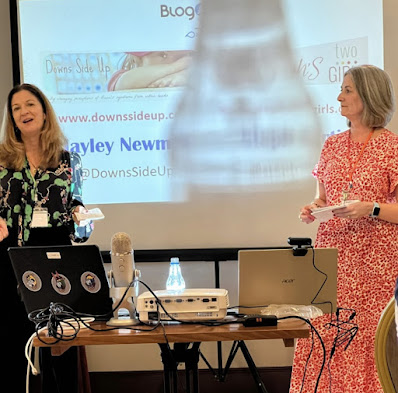
I recently had the pleasure of talking alongside Steph Curtis of Steph's Two Girls on this subject at BlogOn. The sacrifices had our families made, what had our words achieved and the friendships and lessons had we gained along the way? Because over a decade ago we were writing into unchartered territory. No-one had put their family stories out into the public sphere in quite such a way before and we inevitably made mistakes as we found our way, from oversharing to dealing with trolls.


Downs Side Up and Stephs Two Girls
discuss blogging tips at BlogOn


Blog/Family Life Balance

For me, the original motivation for my blog was to buy other new parents precious time bonding with their baby, by dispelling the myths and fear that surrounded the diagnosis of Down's syndrome for me when Natty was born. I wrote what I had needed to read in those early days, but soon found the unexpected benefit that the process of blogging was cathartic and allowed me to access support as well. 

My blog was organic, there was no plan, it just evolved and I wrote in a homely way about what was topical or going on in our lives at that time. But it did take over. It did eat into family time on occasion, despite always trying to strike a balance between creating change and 'putting ourselves out there.' 

And now, post-divorce, I am reworking my blog in order to monetise it without losing its message or my integrity, as that is the perfect work from-home-solution in a post-pandemic world. So now, more than ever as a single Mum, I need to ring fence my time with my girls, and organise my ways of working like never before. 


#AD This is where employee Apps such as Blink, as used by the NHS, can help streamline your workload, aid communication between colleagues and store vital resources all in one easy-to-access platform. 


The Highlights

So, the heady days of parent blogging may be over, where our self-hosted websites were newsworthy and our words won awards. We've all moved on and our words are being crafted elsewhere. Our cute toddlers are now teens who don't want to be photographed posing with gifted products or have their private lives discussed with the world. And that's as it should be. My blog is a more generic place now, filled with facts and resources rather than family anecdotes.

Blogs today may well be slick and professional, but it is important to look back on what we have achieved with our homespun websites. Here are just a few of the things Downs Side Up has enabled me to do alongside my fellow parent bloggers:


Model Natty meets Lorraine


  • Encouraging advertisers to use a diverse range of models.
  • Giving our opinions in the mainstream media.
  • Campaigning for a more inclusive society, for equitable healthcare and education.
  • Advising publishers on how they represent disability.
  • Publishing books and resources.
  • Giving TedX talks.
  • Having tea with the Queen.
  • Being awarded British Citizen Youth Awards for work towards a more inclusive society.
  • Raising huge amounts of money for charity.
  • Supporting other parents in the same boat and changing the narrative around disability.
  • Advising at parliamentary level. 
  • Delivering training to medics and teachers.
  • Writing for magazines, newspapers and other online platforms.


Oh, the places your blog will go!

Quality over Quantity

I know our friend Sarah always got this blog/life balance right, dipping occasionally into her blog more as a way of chatting authentically with others and having a break from her offline job than anything else, but always writing words of great wisdom when she did. 

And I thank her for being in our lives and always being so supportive of others' work. She truly was one of the few who helped give so many of us a leg up. Thank you Sarah. 


George: I am no Poster Boy

Meet George: I Am No Poster Boy


George's Mum Tatty created a Facebook page
called I Am No Poster Boy

Down's Syndrome Diversity

I have always believed in respecting and celebrating the diversity that exists within the Down's syndrome community and I try to show this through a wide range of personal stories on the Downs Side Up Family Stories page. 

Families differ in the range of approaches to life they have, the early interventions they implement, what and how they advocate for their loved ones and even whether they believe an apostrophe or person first language is important or not. The Down's Syndrome Association supports everyone who has Down's syndrome.

Made Possible: Stories of Success
by People with Learning Disabilities in Their Own Words


But it is even more important to recognise and showcase the kaleidoscope of people with Down's syndrome with their infinite combinations of taste, personality, race, culture, sexuality, strengths and needs. There is no such thing as a cookie cutter template for Trisomy 21, and each and every individual has worth and a contribution to make to their family.

Making Chromosomes Count recently ran an article on this important subject in its magazine. 

And social affairs journalist Saba Salman says in her brilliant book Made Possible: Stories of Success, a collection of tales by people with a learning disability, there are many types of success and they come in many forms.

A Mother's Words

So, when George's Mum Tatty got in touch with me to ask if I could help get her son's story our there, I leapt at the chance. Her words and photos lifted my soul, such was the joy flowing from them. Joy, and its twin; love.


George loving life at the beach

Down's Syndrome: Sally smacks medics between the eyes with screening truths


Sally Phillips addresses 4000 at the Royal College of Gynaecologists World Congress 2019


Sally Phillips is one incredible woman who has endured more than her fair share of front row hecklers, not just as a comedy actor, but also when she created the brave and thought-provoking BBC Documentary A World Without Down's with film maker Clare Elizabeth Richards. It got everyone talking about the thorny topic of screening. And more crucially the even pricklier topic of 'screening out' babies with Down's syndrome.
"The right words at the right time 
to the right people"
3 years on and Sally's film afforded her the opportunity to speak to 4000 obstetricians and gynaeclogists from all across the globe. I am proud to be able to share the transcript below. 

We Interview the Woman Behind the Camera: A World Without Down's?

 This very evening the 5th October at 9pm on BBC Two a ground-breaking new documentary co-written and presented by actor Sally Phillips airs. It's called A World Without Down's? and talented film-maker Clare Richards was the woman behind much of the filming and editing. Downs Side Up asked her a few questions.


Clare Richards was the woman behind the camera filming A World Without Downs?

The powerful piece looks at Down's syndrome screening programmes and asks some important ethical questions about our views on disability as a society. I was enormously proud to have been filmed whilst training medical professionals for the programme along with our daughter Natty. 

Key scientists and ethicists, as well as champions with Down's syndrome and their families, also feature in a work that will start important conversations everywhere. Never before has a programme asked the opinions of those with Down's syndrome on such an important topic either.

The country is in a media frenzy with Sally Phillips at the helm. Media interviews are like beacons of light flashing across the country as our community rallies. Here's my pennyworth on BBC Breakfast yesterday. 

But with all the focus on the protagonists in the film, rarely does anyone ask the film creator about their role in bringing such an important topic to our screens.

So I threw a few questions at Clare, and asked her what she's working on next and here's what she told us.

***********

How were you selected to work on A World Without Down’s? What drew you to the subject?

I’m always interested in subjects where minority or alternative voices get a platform to express themselves more fully, so when I heard about this project I was naturally drawn to it.


You work alone at times. Tell us about the different roles you perform in creating a film such as this.

There’s always a big team in the background keeping a production moving forward in all directions, but with this project there was an awful lot to read and lots and lots of people to meet before we did anything – it’s complex, in fact I was continuingly researching the whole way through the process. 

I was also self-shooting the documentary, keeping in touch with the many contributors, as well as working to a schedule that had to co-ordinate with Sally’s very busy timetable and making sure that a mutli-layered subject was fairly discussed in a way that was going to be accessible to a broad audience.
 
Clare tells us about the making of BBC Two's A World Without Down's?


Tell us about an average day for a documentary maker.

There really is no average day – I could be anywhere, talking to anyone about anything. But it will usually involve lots of research to ensure you fully understand your subject matter, I needed to ensure that I could communicate the subject to the general public. So lots of reading, phone calls, meetings with experts and people involved in the subject matter and also to those who hold the subject close to their hearts.


The film features some very personal moments and a range of raw emotions from various people. How do you feel witnessing these? How do you ensure authentic emotions are expressed. Do you ever put the camera down and give your subjects a hug?

It’s always a real privilege to be a witness to sensitive situations where emotion is raw. I hope that I develop good relationships with people before we film anything emotional so that people can feel comfortable, or comfortable enough to be genuine when we do film. It’s often easy to spot when emotion isn’t real and if it is disingenuous it won’t tend to be used in the final programme. From years of experience I will sense when I’ve filmed enough so that I can give people space that they need or give them a hug.


Was it a straightforward process? How many hours of film, countries visited, nights away from home, extra takes etc 

It wasn’t straightforward at all! We filmed about 18 days with Sally in America, Iceland and the UK, which isn’t a lot of time, but the work that went into each day’s filming was quite considerable. Carl, the producer was constantly juggling information, schedules and relationships with a huge variety of people with lots of different opinions.


How did you begin to decide what made it into the final edit.

You look at everything and then start whittling it down, being mindful of the fact that you have to weave a narrative that takes people on a journey that is surprising, informative and entertaining, if possible!


What was your personal experience of Down’s syndrome when you were growing up? 

I didn’t have a huge amount, I didn’t go to school with anyone with Down’s and I didn’t know anyone outside school with Down’s either. However, my Dad worked for a charity that raises money for people with learning disabilities for 10 years. He organised the funding of a mini-bus for the local Down’s group in Somerset called Ups and Downs Southwest, which is run by Wendy O Carroll and he was always really struck by her son Oliver, who is a very successful photographer. The first film I made was called Disabled and Looking for Love, about dating and love for disabled people so I guess I’ve always been empathetic.

(Read the Downs Side up interview Focus on Oliver Hellowell here.) 


What did you learn from making the film, both professionally and about DS?

I learnt a great deal more about Down’s syndrome than I knew before, it really does feel like an outdated view of what Down’s syndrome prevails. I learnt a great deal more about bioethics and the science of genetics and that was fascinating too.

Are there any moments in the film that really stand out for you and what are you most proud of?

I’m proud of the sequence with Sally and Ollie on the Southbank because it feels very intimate. It was also important for the film that the viewers are able to witness Sally being a mother and I feel through this scene you truly see this and it’s really beautiful.

I’m proud of the fact that a lady that has terminated pregnancy felt able to contribute to the programme. It was an incredibly brave thing to do and I hope it helps other women like her feel able to talk about to their experiences so they’re less stigmatised.

I’m proud of the fact that I’ve been able to tackle a difficult, complex and emotional subject in a way that hopefully draws people in and makes them think and discuss.


Tell us about your other/future projects. 

I’ve just started on a project for BBC 2’s This World international current affairs documentary strand which will be following a British doctor with albinism as he investigates the persecution that Albinos experience in East Africa.

See more of Clare's work on her website. 


BBC Three Bust Myths with New Films: Down's Syndrome

BBC Three have been working on a fantastic series of films which bust myths. The first of these that caught my attention was a hilarious yet informative short, featuring my beautiful friend Victoria Wright. 


Watch What Not to Say to a Person with a Facial Disfigurement here.  

Apparently Bio Oil won't help, in case you were wondering...


BBC Three create new myth-busting film about Down's syndrome

How Do Passionate Campaigners Change the World?

The beauty of being an intermittent Radio 4 Woman's Hour listener means that you often find the answers to pertinent situations in your life precisely when you aren't looking for them.


How do passionate campaigners change the world?

When pondering the ethical conundrum of new antenatal screening programmes whilst peeling potatoes in the kitchen yesterday, I heard National Poet of Wales, Gillian Clark talk about her poem Letter From a Far Country. 

She had written it in protest but instead it was lauded as a celebration upon launch. She explained the sudden realisation back then that being positive is what creates real change. 


"Now, if I want to save the planet, I praise the planet," she advised.

BBC Inside Out Documentary : Parent Power


We've been working with the BBC Southwest Inside Out team for about three months now, to produce a short documentary about antenatal screening and support for new families, as well as highlighting the need to liaise with medical professionals to improve their terminology at point of diagnosis.

A Year of Advocacy, Collaboration and Inclusion


What have we achieved? What have we learned?

The highs, the lows, the collaborations and challenges that made, or nearly broke us. 

Where will the next year take us? 
Who knows. But here are just a few of the moments from 2014 that have shaped our campaigning and advocacy.


The highs and lows of 2014 for Downs Side Up


8 Things my Blog has Taught Me over 2 Years


It is 2 years since I nervously sent my first unhoned musings out into the ether via the World Wide Web. Read Blank Blog Blindness here, where I talk about,  

"a feeling of wanting to get something much more important, 
very right from the onset.  
Of wanting to create something that will lift spirits, give support, bring people together, raise a smile and encourage. Yet all the while providing practical tips and real solutions for the everyday lives of parents and educators who have a child with Down's Syndrome in their lives." 


Motivation

Convinced no-one would read, I nicknamed it 'my little blogette', the sharing of our family life with 2 gorgeous daughters, one with Down's syndrome. My motivation was, and always has been, to buy precious early time for parents following a diagnosis. To show them that this path less travelled is never dull, that their lives will go on pretty much as before, and that with the right support their children will achieve great things. To dissolve and shine light on the kind of fear that consumed me in the early months after Natty's birth. An all-round Down syndrome support blog was my aim.

But what has my blog taught me? What have the unexpected lessons been? How has it changed my family? Where has it taken me, my values and thinking? And what has it achieved for others?

1 Blogging is time consuming

As the photos show, 'blogging' doesn't really describe what has become a full time unpaid job for me now. Speaking, writing, training, learning, meeting, talking. If you're thinking of starting a blog you might want to set strict limits for it from the outset. I probably spend 7 hours a day Mon-Fri on associated work, and I'm late for everything because I'm always trying to squeeze in one last call or email or Tweet.

Why do I do it? Why don't I say no when I'm asked to write an article for nothing that takes a week of my spare time? Why do I do an unplanned radio interview at 10 minutes notice which leaves me shaking with adrenaline all day?

Because when I discovered that people enjoy reading and listening, it made it all worthwhile. When one acquaintance said that before reading Downs Side Up she had felt sorry for our family and now she doesn't, I suddenly knew I was changing the perceptions of the wider public towards not just Down's syndrome but disability in general. When a new Mum wrote to me from her maternity ward bed having discovered us via Google, saying that the blog was the only thing giving her hope for her new baby with Trisomy 21, I knew I couldn't stop writing.

I'm still never prepared for the honest, open and heartfelt emails and comments that come my way, often anonymously: 

"Your blog has keep me going the last 3 months," 
"thank you for showing us that there is light at the end of the tunnel", 
"I hope I will one day be as positive as you are", 
"I keep your newspaper articles in my kitchen drawer to boost me on the bad days",
"My friend had a termination but having read your blog she is going to try again and will not have testing this time."


A Typical Day

Wake up and drag self out of bed after 3 alarm bells
Shout 'shoes' and shovel breakfast in the girls while they create dinosaurs or similar
Do school run
Home and prepare dinner (usually chucking a stew in the slow cooker)
Check and replay to emails
Check and post on all social media sites: Twitter, Pinterest, Facebook, LinkdIn, Tumblr, Google+
Write an article for a magazine or journal
Turn down about 5 emails to do reviews
Pick the odd 1 relevant review
Plan my Special Needs Jungle and Britmums columns plus any guest editing I'm doing
Join in any live Twitter chats 
Interview any guest bloggers
Chat to the latest documentary maker or journalist needing advice or a quote
Think about writing a blog post of my own.... time usually short for that.
Run out the door 5 mins late for school grabbing 'lunch' on the way
Do errands, docs appts etc
Homework, precious time with the girls, bed time and stories
Tidy up and the finish off the things that got started during the day (if I don't fall asleep before).

* I never let blogging encroach on family time, so after school and weekends are off limits.*


2 It's an emotional journey

I never for one minute expected blogging to be so all-consumingly emotional when I started. There are days where it gets too much and I have to step back, days of grief where a family I've got to know online have lost a baby, or of fear when I have had to go to the Police about a particularly nasty troll and the bigots voices surround us. A couple of days off usually brings the strength to continue shining a light into dark corners.

Then there are the times when I have been more nervous than I knew possible, frozen with fear over a live Skype BBC TV interview on a tricky subject or speaking to a room of MPs, adrenaline sending me to the smallest room in the house over and over. Then the moments of pride, reduced to tears because Natty has another modelling job or someone has noticed the reason for the long hours and nominated DSU for an award: Outstanding Contribution, Inspire, Woman of the year, Local Hero. And then the invite to Number 10.
None of it seems deserved and I am left humbled. And often crying but more determined than ever.

Yet, dear blog, I have grown a thicker skin, become wiser in so many ways.


3 Blogs have a life of their own

The work surrounding the blog has been organic. There is never a plan in mind, I just follow it's lead. Sometimes Natty's modelling or an award leads to a lot of media work. Likewise if something happens that demands attention I will write for change, e.g. getting a bigot removed from office for example, campaigning for a law change or calling for justice for someone wronged. Then I will be invited to do various events, such as speaking at conferences or Parliament. For this I research the subject matter in depth, such as the facts surrounding disability abortion law, sometimes there are facts I wish I hadn't read. 
Other than that I watch my family and listen to my heart and thoughts in the quietest of moments and write about them.

Just as the direction a blog takes can change unexpectedly, the posts which are read the most is often surprising. It's never the posts that you favour as a writer, never the ones which are the most well-wrtten, but often the most controversial. I am however happy to say that my all time most popular post is the most useful. It's the one that I read at Britmums last year and made you all cry. What to Say When a Baby is Born with Down's syndrome.


4 Writing is unexpectedly cathartic, healing and educational

Writing and speaking about the complicated emotions that come with an unexpected diagnosis for our baby was intended to help other parents, to let them know that everyone adjusts in their own time and way and that a full range of feelings is entirely typical. What I didn't realise was that through that writing, you organise those jumbled thoughts until you reach a point where they all make sense even to yourself, but you will bring them to the fore again. I have spent many evenings crying over the pc, pouring my heart into a post. It's a hugely cathartic and healing process, like free therapy I suppose! 

And by blogging those thoughts you enable friends and family to read them in privacy and at a time that suits them as well. You are able to explain in a way that you would never be able to face to face, and that helps them understand.

Alongside that, blogging is a learning curve. How do write this and pin that and post the other. And the research involved is like doing a degree!

5 There is so much online support

Above all of this I am thankful for the internet enabling the words of bloggers and charities  and support groups and writers and forums and professionals and other parents to help others, but also to bring the support I need in to me at a moment's notice. I am grateful to be part of such a supportive online family, working together to change the world one attitude, one law, one person at a time. Thank you all. If you are reading this, it's you too.

I am eternally thankful for the friends I have made along the way be they parents of other children with Down's syndrome, wise parents of adults, professionals with Down's syndrome or bloggers who make me giggle when I need a change or give me technical advice when I am stumped. Online friends who lift me when I'm tired, authors and artists and playwrites and actors, even some lovely media folk who have remained constant advisors and friends (in between those who would sell their granny for a story). I always said Natty was a great ice-breaker, but our family has met so many wonderful others whose paths would never have crossed otherwise.

6 Not everyone will understand

I can think of one or two, no more fortunately, people in our local community who have barely spoken to me since the media coverage of Downs Side Up began. I wondered at first if they misunderstood my motives, thinking I was trying to be like Jordan and revel in the public eye. Then I wondered if jealousy was playing a part, but finally someone pointed out that blogs like mine hold up a mirror for others to see their own reflection in. And as we are bringing about a subtle change, they see this is a criticism of the way they were doing things before...


7 Blogging can be costly

Paid for every click you say? Ha! Is that one of those urban myths!?

I do get a lot of requests to write reviews, usually in exchange for a cheap plastic toy. 
I say no of course. 

Other writers ask if they can put a post about insurance on my blog. 
I say no again. 

I took adverts off the blog after a few weeks because it was distracting. 

Now there is nothing wrong with blogging for payment, I just choose not to do it because I don't have time and I want the message of Downs Side Up to be clear. So yes, it costs me more than I earn. Software, domain name fees, hosting fees, train fares, blogging event tickets, accommodation, even postage. 
Worth every penny though. 

8 You have to do it naked

Not strictly true of course, but, spurred on by Kate on Thin Ice, getting naked to bring awareness of miscarriage, to encourage mums to celebrate their post-birth bodies and to forgive them for the losses while raising money for Down Syndrome Awareness Day was just one of the more curiously unexpected events of the year. Read Downs Side Up Uncovered here to find out more.

I wonder what the next year will bring?

I hope you'll pour balm on more hearts dear blog, open more eyes, make some real change, get our collective voices heard. I know you'll bring new friends, new inspiring plays or films or dance or books to watch and review. I will meet more adults with learning disabilities who will lead the way. We'll learn more tips and tricks to make life easier, often from medical or teaching professionals and we'll share them in the melting pot. Blog, you are now a hub, drawing inspiration to you like a powerful magnet. Thank you.

Oh, and who knows, maybe I'll find a sponsor!


You might like to read our most popular post 


Down Syndrome Awareness Month 2013 #DSAM2013

As parents and siblings and carers of children with Down's Syndrome we very quickly become top experts in our field. 
We are: 

doctors 
teachers
speech therapists 
story tellers
geneticists
physios
occupational therapists 
play specialists
artists
tailors (I'm very good at sewing up hems on sleeves)
nutritionalists
campaigners
historians
fighters
carers
mentors
spokespeople


The list goes on of course, but I for one wasn't quite so knowledgeable about what it meant to have Down's Syndrome when Natty was born nearly 7 years ago.
It has very much been a crash course, with Natty as our greatest teacher.


So I think we should be a little gentle on those who aren't in the 'inner circle' and don't quite have all their facts straight. Those who don't quite get the terminology correct or believe an outdated generalism to be true. Why would they? 

Certainly everyone is 'aware' of the condition, knows what Down's Syndrome is, looks like at least. And for we parents and those in the charity and support sector every single day is Down Syndrome Awareness Day/Month/Year.

So why are we doing this...? Do we need a Down Syndrome Awareness Month?

Well, as long as new parents continue to feel as worried and confused as we were in the early days, as long as 92% of parents with an antenatal diagnosis feel that Down's Syndrome is so scary that a termination is the only answer, as long as a professional working with adults with DS exists in the land who comes out with bafflingly ridiculous statements like "He could speak really well before he caught the Down's Syndrome," and as long as individuals with DS are the target of hate crime, offensive language or inexcusable bigotry around the world, then I feel an Awareness Month can only be a good thing.

And to those whose heart is in the right place but who let insensitivities slip, we can gently put them straight.


So, to raise awareness of certain issues or causes that you are involved with, to iron out a few myths, to signpost support groups or invaluable information, to let us know about charity events or to share your all time favourite blog post or article, please attach them in the comments section below, or join the blog hop linky at the bottom of this post. 

A blog hop also means that you visit others' posts, so this is a super -de-duper way of bringing the Down's Syndrome community together, making us all stronger. You can copy the code at the bottom to add to your post and the others in the linky will appear on your blog too.

Let's see if we can get 31 at least, one for every day of the month. 

Let's make a change together.